
Property insurance premium rates are increasing by 25-30 per cent, primarily due to a reduction in discounts, following substantial claims from natural calamities like the Gujarat floods, which caused an estimated 5,000 crore in losses.

The Insurance Regulatory and Development Authority of India (Irdai) has proposed a phased reduction in the expenses of management (EoM) limits for insurers, aiming to lower the overall cost of insurance and enhance returns for policyholders. The proposals also include a new framework for commissions, stricter measures against mis-selling, and mandatory cost audits.
The Insurance Regulatory and Development Authority of India's (Irdai) recent actions against insurers for breaching expense of management (EoM) limits indicate a serious commitment to enforcing operating and distribution cost controls, according to industry experts.

Insurers are bracing for claims worth nearly 5,000 crore from the recent floods in Gujarat, predominantly for property losses, though they do not foresee an increase in premiums within the competitive property insurance market.

If a bank sold the policy, complain to its grievance cell and, if necessary, escalate the complaint to the Reserve Bank of India Ombudsman.

InsuranceDekho and RenewBuy have merged to establish India's largest artificial intelligence (AI)-enabled insurance distribution platform, targeting a significant premium book and extensive reach across the country.

Life Insurance Corporation of India (LIC) is facing a thinning of its top management as Managing Director Dinesh Pant exits to join Irdai, leaving one of four MD posts vacant. This comes amidst broader staffing challenges across several public sector insurers and a headless Financial Services Institutions Bureau (FSIB).

The Centre has announced a major bureaucratic reshuffle, appointing Prakash Rajpurohit as Deputy Election Commissioner and approving appointments for 27 civil servants at joint secretary and equivalent levels across various ministries and departments.

The Telecom Regulatory Authority of India (Trai) has expanded the 1600-number series to include utilities, courier, and logistics companies, introducing the new 1601 series to help consumers identify legitimate calls and prevent widespread fraud and impersonation.

Premature surrender and withdrawal of life insurance policies in India have surpassed maturity payouts over the past five years, indicating a growing trend of policyholders exiting long-term policies before their full tenure, according to data presented in the Lok Sabha.

The Insurance Brokers Association of India (IBAI) has warned that the IRDAI's proposed overhaul of insurance distribution practices could lead to a 70 per cent fall in revenues for intermediaries and result in 10 lakh job losses, citing concerns over the tight feedback deadline and the global uniqueness of the proposed architecture.

The Union Cabinet on Friday approved 100 per cent foreign direct investment (FDI) in the insurance sector, a move that was welcomed by industry as it would help attract more capital and global expertise, while boosting insurance coverage in the country. A bill to amend the insurance law is likely to be tabled on Monday in Parliament, whose winter session is slated to conclude on December 19.

Jio Financial Services and Munich-based Allianz Group have signed a binding agreement to establish a 50:50 joint venture for general and health insurance in India, building on an earlier reinsurance partnership.

Following the notification allowing 100 per cent foreign direct investment (FDI) in the insurance sector, the Finance Ministry has revised norms to remove the requirement that a majority of directors and key management personnel in an insurance company with foreign investment be Indian residents.

'We see a lot of cases of bank deposits getting lost, especially when people die, so this will help address that because you have one consolidated view.'

The committee formed under the Life Insurance Council to review the commission structure in the life insurance sector has recommended capping distributor commissions or deferring them to ease acquisition costs. The recommendations will be sent to the insurance regulator -- Insurance Regulatory and Development Authority of India (Irdai).

List all unavoidable expenses such as rent, groceries, transportation, education and medical bills.
Finance Minister Nirmala Sitharaman on Tuesday said that raising the FDI limit to 100 per cent in the insurance sector will help attract more capital, improve competition and increase insurance penetration by making policies more affordable.
The insurance industry is trying to get to grips with provisions in the proposed Insurance Amendment Bill, which gives additional powers to the Insurance Regulatory and Development Authority of India (Irdai), while there is ambiguity in the very definition of the insurance business, according to industry experts.

Shares of Indian life insurance companies, particularly SBI Life Insurance and Canara HSBC Life Insurance, saw significant declines after the Department of Financial Services (DFS) secretary, M Nagaraju, stated that banks are being asked to avoid exclusive tie-ups with their own insurance subsidiaries and instead remain neutral.

Insurance intermediaries who receive disproportionately high commissions are likely to see a decline in their payouts, post the new Insurance Amendment Bill. The new Bill gives the Insurance Regulatory & Development Authority of India (Irdai) the power to disgorge unlawful gains made by insurers and intermediaries as well as the right to limit commissions paid to intermediaries.

Sebi is working with other regulators to expand the CAS framework.

It is because dealing with a regulatory system that is largely headed by retired IAS officers then becomes relatively easy, points out A K Bhattacharya.

A senior citizen in Navi Mumbai was allegedly swindled of 64 lakh over four years by cyber fraudsters posing as insurance regulators and grievance officials.
The government has circulated among members ofParliament a new draft of the Amendment of Insurance laws Bill, 2025, proposing stricter safeguards on the utilisation of life insurance funds and other specified insurance business funds, particularly for dividend payouts, bonuses, and servicing of debentures.

'Indian private sector hospitals provide quality healthcare at a fraction of the global cost.'

The Anil Ambani Group's financial services arm Reliance Capital on Wednesday said it has received in-principle approval from insurance sector regulator Insurance Regulatory Development Authority for its proposed 26 per cent stake sale in Reliance Life Insurance to Japan's Nippon Life.
'It will support our growth aspirations. It's very positive as it helps expand the market in a segment that really needs it.'

LIC offices will remain open during normal working hours on Tuesday for customer convenience, following an advisory from Irdai. CoinDCX commits to invest in cybersecurity infrastructure, and PayNearby introduces UPI QR-based cash withdrawals.

Even as non-life insurers reported muted premium growth in October, standalone health insurers saw a robust 38 per cent year-on-year (Y-o-Y) surge. This growth was driven by pent-up demand in the retail health insurance segment.

'By quick, fast, and just awards, the insurance ombudsman can bring the trust of the policyholders in the insurance system and insurance as a product and create a positive impact on the entire industry.'
SBI General Insurance aims to achieve a 10 per cent market share among private and standalone health insurers within approximately five years, up from its current 7.17 per cent, said Naveen Chandra Jha, managing director and chief executive officer, SBI General Insurance.

The Indian government is reportedly considering increasing the foreign direct investment (FDI) limit in the pension sector to 100 per cent, bringing it in line with the insurance sector. A Bill to amend the PFRDA Act, 2013, is expected in an upcoming Parliament session.

India's market regulator is moving ahead to include real estate investment trusts (Reits) in benchmark indices in a phased manner, Sebi chief Tuhin Kanta Pandey said, while asserting that the regulator was working to strengthen the link between infrastructure building and the markets.

The government is likely to introduce a bill seeking amendments to the Insurance Act, 1938, during the upcoming Budget session to achieve 'Insurance for All by 2047'. Some of the provisions, which could be part of the amendment bill, include composite license, differential capital, reduction in solvency norms, issuing captive license, change in investment regulations, one-time registration for intermediaries and allowing insurers to distribute other financial products, sources said.

The challenge for India lies in navigating complex landscape to its best advantage. The BRICS Summit will test its navigation skills, asserts former foreign secretary Shyam Saran.

Recent years have been turbulent for the insurance industry due to direct and indirect tax reforms, regulatory overhaul and other external pressures. The events cumulatively slowed growth rate to single digits from the high teens seen earlier.

The focus is now on accelerating PSP development through faster approvals, better-quality detailed project reports (DPRs), simplified clearances, and early excavation permissions. Speaking at a recent event, Prasad said hydropower and PSPs would be central to supporting India's renewable energy expansion by providing the reliable and flexible capacity needed to balance rising solar and wind generation. "A huge amount of variability is getting introduced into the grid.
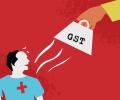
The exemption of individual life and health insurance premiums from the Goods and Services Tax (GST) enables the insurance industry to make products affordable and attractive, said Ajay Seth, chairman of Insurance Regulatory and Development Authority of India (Irdai) at the Business Standard BFSI Insight Summit 2025.
The All India Insurance Employees' Association has opposed the government directive seeking to open up top posts in the state-owned insurers to the private sector, saying this would lead to greater private influence and "eventual privatisation".
